Industrial & Technical Heritage Street Lighting – Holophane, GEC, Thorn & Revo
Historic Background: The Engineering Era
Mid-20th century British street lighting represents a significant shift from decorative Victorian cast iron to engineered industrial design. Between approximately 1930 and 1975, manufacturers such as Holophane, GEC (General Electric Company), Thorn Lighting, and Revo Electric developed lighting systems based on scientific light distribution principles rather than ornamental forms.
This period introduced prismatic glass refractors, die-cast aluminium housings, and standardised optical systems. These innovations enabled wider street coverage with fewer lamp posts, reduced glare for motorists, and simplified municipal maintenance programmes.
Today, these industrial-era lights are recognised as important examples of British mid-century engineering heritage and are valued for restoration projects in railway infrastructure, post-war conservation areas, and brutalist architectural sites.
Holophane: Prismatic Glass Refraction Technology

Holophane prismatic unit displaying patented glass ribbing and optical refractor design.
Holophane lighting, founded on an 1893 patent by French engineer André Blondel and Greek engineer Spiridion Psaroudaki, represents a significant technical development in street lighting history. Unlike traditional lanterns using simple reflectors, Holophane units employ prismatic refraction — precisely calculated glass prisms that control light direction through optical physics rather than mechanical reflection.
The distinctive borosilicate glass bowls are engineered optical instruments, not decorative elements. Internal and external prism patterns distribute light efficiently across road surfaces while minimising glare and light spill.
This optical precision made Holophane the preferred specification for railway terminuses, civic squares, and high-specification industrial environments. The characteristic prismatic “sparkle” cannot be replicated by modern equivalents, making Holophane units particularly valued in conservation projects where authentic period lighting is required.
GEC & Thorn: Post-War Municipal Lighting
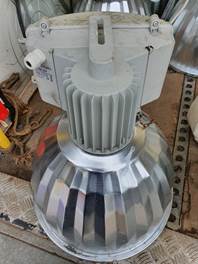
GEC and Thorn post-war municipal lanterns showing characteristic die-cast aluminium cobra-head profiles.
Post-war British urban redevelopment saw widespread adoption of die-cast aluminium street lighting. The General Electric Company (GEC) and Thorn Lighting led this modernisation, producing robust, maintenance-efficient lanterns for local authority installations.
The Thorn Alpha and Beta series, along with GEC Z-Series models, became standard municipal equipment throughout the 1950s and 1960s. These designs are characterised by aerodynamic “cobra head” profiles, integrated optical refractor plates, and lightweight aluminium construction that simplified installation and maintenance.
Thorn Lighting originated from the acquisition of Atlas Lamp Works Ltd in 1932 by Jules Thorn, with lighting activities consolidated under Atlas Lighting Limited in 1957. In 1969, the company name changed to Thorn Lighting Ltd, and the Atlas brand name was subsequently phased out.
GEC and Thorn units are now recognised as essential elements of mid-century modern (MCM) conservation areas and brutalist architectural sites. Their streamlined industrial aesthetic represents a distinct period of British urban design.
Revo: Heavy-Duty Industrial Lighting
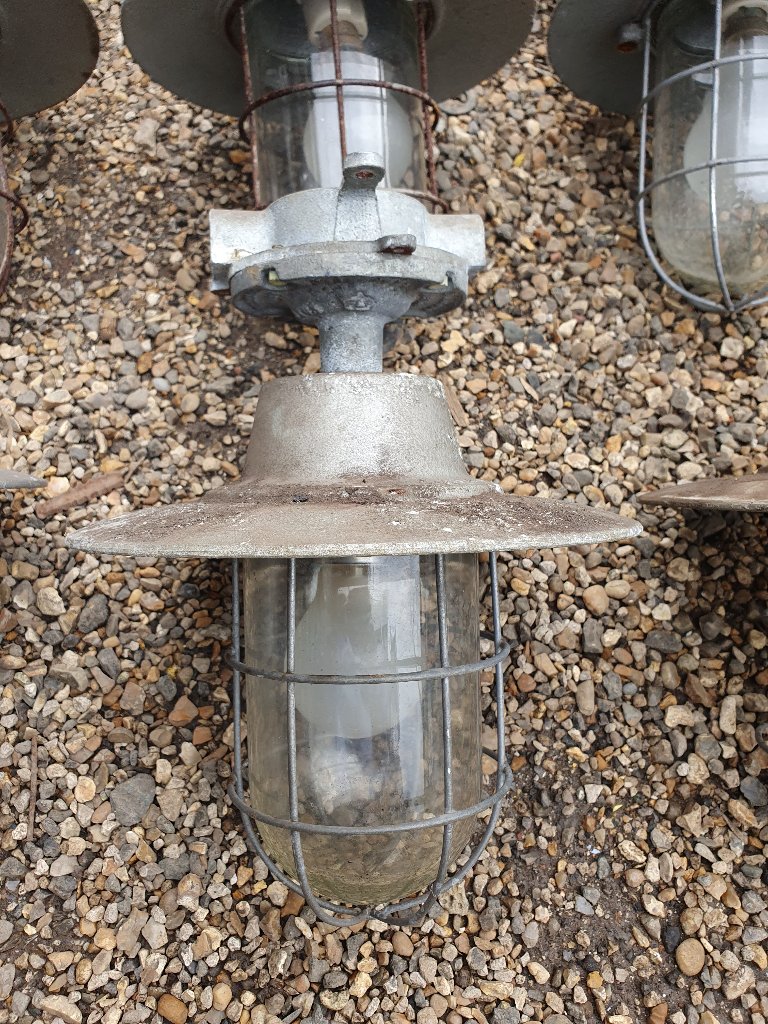
Reclaimed Revo industrial lanterns showing characteristic heavy-duty construction and enamel finish.
Revo Electric Company Limited, based in Tipton, West Midlands, specialised in robust industrial lighting for factories, dockyards, and heavy engineering environments. Founded in the early 20th century, Revo became a household name in the 1930s when electric street lighting was widely introduced throughout the UK.
Revo units are characterised by vitreous enamel finishes and substantial construction designed to withstand harsh British industrial conditions. The company was one of the UK’s largest manufacturers of industrial and street lighting equipment, control gear, and electrical goods, employing 2,000 people at its peak in 1961.
From factory floor bulkheads to high-street column lanterns, Revo lighting represents functional industrial design prioritising durability over ornament. These units are now valued for their utilitarian aesthetic and engineering integrity, preserving an important element of Britain’s industrial manufacturing heritage.
Reclaimed Industrial Heritage Lighting at Fenori
Fenori handles reclaimed mid-20th century industrial street lighting from various manufacturers. As with all heritage lighting, availability varies based on procurement from local authority upgrades, railway infrastructure renewals, and industrial site clearances.
Previously handled and archived examples have included:
- Holophane prismatic glass lanterns, various sizes and mounting configurations
- GEC Clearside street lights and Z-Series die-cast aluminium municipal lanterns
- Thorn Alpha post-war cobra-head and traditional form lanterns
- Revo industrial wall-mounted bulkheads, column lights, and factory-specification units
- Mixed manufacturers including Atlas, BTH, Simplex, and other British industrial lighting makers
For current and archived stock, use this industrial heritage lighting stock search.
These reclaimed items are suitable for:
- Railway and industrial heritage restoration projects
- Mid-century modern conservation areas
- Brutalist and post-war architectural sites
- Film and television period productions (1940s–1970s settings)
- Private estates, gardens, and landscape projects
- Architectural feature lighting and interior conversions
- Municipal heritage streetscape projects
Heritage Street Lighting – Related Styles
Fenori specialises in reclaimed British heritage street lighting. Explore other classic designs in our collection:
- Rochester Street Lights – traditional upright lanterns, Victorian and Edwardian municipal lighting
- Sugg Street Lights – William Sugg & Co. early 20th-century gas and electric designs
- Wornum Street Lights – mid-century London street lighting, post-war elegant lantern forms
- DW Windsor Street & Exterior Lighting – contemporary traditional-style exterior lighting
- Urbis Street & Exterior Lighting – modern heritage-style luminaires for public realm schemes
See how these heritage street lights have been used in real projects in our Customer Projects & Installation Gallery.
Availability and Enquiries
Because reclaimed industrial heritage lighting is no longer manufactured, availability varies and items may not always appear online.
For current stock, specific model enquiries, or restoration consultations:
Telephone: 07770 836 457
Email: sales@fenori.co.uk
Browse our wider range of heritage street lighting available for sale or hire.
Verified Heritage References
- Historic England – Listed Street Lighting Search
- Holophane Company History – Archives at Science Museum Group Collection
- GEC Heritage – British Industrial History, archived at Birmingham Museums Trust
- Thorn Lighting Archive – Museum of Science and Industry, Manchester
- Revo Electric Company – Grace’s Guide to British Industrial History