Suggs Street Lights β History, Heritage Lighting & Reclaimed Examples
Historic Background: William Sugg & Co
William Sugg & Co was an important British lighting manufacturer, established in 1837 in London. The company became known for its gas lighting products and later for early electric lighting equipment, and its lamps were widely used in streets, public buildings, and institutions throughout the UK and abroad.
One of the companyβs key innovations was the Argand burner, a more efficient gas lamp design that helped improve the brightness and quality of public lighting in the 19th century.
Sugg products evolved over time. By the early 20th century, William Sugg & Co was manufacturing both gas and electric lighting equipment, including decorative street lamps and specialist fittings that were popular in civic and commercial lighting schemes.
Historic Examples of Suggs Street Lights
Suggs-manufactured street lamps and lanterns have been preserved as part of the UKβs built heritage. Examples include:
-
Lamp posts outside 24 Russell Street, London β a cast-iron lamp post made by William Sugg & Co (dating from around 1910), featuring a later upright Rochester-type lantern. This item is listed at Grade II on the National Heritage List for England due to its historic and architectural interest.
π Historic England listing: Lamp post outside 24 Russell Street β Grade II listed example of historic street lamp design. -
Lamp post on the corner of Garrick Street & Rose Street, London β another Grade II listed Sugg-manufactured lamp post combining a decorative Sugg column with a later Rochester-style lantern.
π Historic England listing: Lamp post on Garrick Street & Rose Street β example of gas street lighting heritage.
These official listings by Historic England demonstrate the significant historical and architectural interest given to street lighting produced by William Sugg & Co and the later use of Rochester-type lanterns on these posts.
Why Suggs Street Lights Matter
Historic street lighting reflects several important developments in urban history:
- The transition from gas to electric lighting in cities
- The rise of decorative cast-iron street furniture in the 19th and early 20th centuries
- Lighting manufacture by specialist firms like William Sugg & Co, which were part of the broader history of public illumination and industrial innovation
- By connecting to real heritage examples, Suggs lamps are more than decorative: they are part of the story of how British cities were lit and experienced over time.
Reclaimed Suggs Lights at Fenori
At Fenori, we handle reclaimed Suggs street lights and components that reflect this heritage tradition. While stock varies and items may not always be listed online, our archive has included:
- Suggs street lamp heads
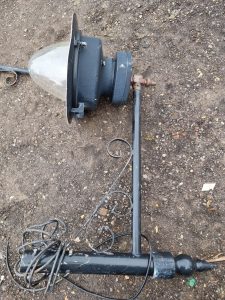
- Posts and ornate brackets
- Swan neck-mounted Suggs lights
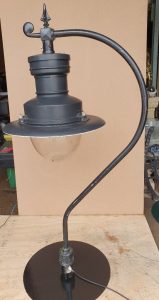
- Upcycled and rewired Suggs lighting on stands
These pieces are suitable for use in:
- Architectural and landscape design
- Garden and outdoor lighting features
- Film, TV, theatre, and event productions
- Decorative installations where historic lighting character is desired
Some examples of Suggs lighting items you may find include reclaimed street lamps fitted to ornate brackets or refurbished Suggs lamps mounted on stands for flexible display. Β use a search to find our current stockΒ
Β


Heritage Street Lighting β Related Styles
Fenori specialises in reclaimed British heritage street lighting. Explore other classic designs in our collection:
- Rochester Street Lights β traditional lantern forms used across the UK
- Suggs Street Lights β early 20th-century municipal lighting
- Wornum Street Lights β mid-20th-century London street lighting style
See how these heritage street lights have been used in real projects in our Customer Projects & Gallery.
Availability & Enquiries
Due to the uniqueness and irregular return of reclaimed heritage lighting, Suggs street lights may not always be in stock online.
To check current availability, refurbishment and rewiring options, or to discuss bespoke sourcing:
π 07770 836 457
βοΈ sales@fenori.co.uk
You can also explore our wider range of heritage street lights for sale or hire here:
π https://fenori.co.uk/hire-1
See examples of past Suggs stock and installations in our Customer Projects & Gallery:
π https://fenori.co.uk/customer-pictures-1
Suggested External Links (for further reading)
-
Historic England β Lamp post outside 24 Russell Street (Grade II listing): https://historicengland.org.uk/listing/the-list/list-entry/1486682
-
Historic England β Lamp post on Garrick Street & Rose Street (Grade II listing): https://historicengland.org.uk/listing/the-list/list-entry/1491345
Verified Heritage Street Lighting References
For those interested in historic British street lighting, here are authoritative references for Rochester, Suggs, and Wornum styles:
- Rochester Street Lights: Examples of historic Rochester-style lanterns and posts listed on the National Heritage List for England.
- Suggs Street Lights: William Sugg & Co, established in 1837, produced historic street lighting still preserved in the UK.
- Wornum Street Lights: Mid-20th-century street lighting style commonly found in London and conservation areas.
These references demonstrate the historical significance and preservation of British heritage street lighting across the UK.
Suggs Street Lights
William Sugg & Co. is the UK’s oldest lighting company, founded in 1837 by William Sugg. The company began as a gas lighting manufacturer and quickly became a leader in the field, supplying gas lamps to cities and towns all over the UK. In 1849, Sugg invented the “Argand burner”, a more efficient and brighter gas burner that revolutionised the lighting industry.
In the early 20th century, Sugg began to manufacture electric lighting equipment as well. The company also developed a number of innovative gas and electric lighting products, including the “Sugg mirror head” and the “Sugg flambeaux”.
Sugg’s lamps can be found all over the world, and the company has a long history of working on prestigious projects. In 1851, Sugg supplied the gas lamps for the Great Exhibition in London. In 1908, the company supplied the electric lamps for the coronation of King Edward VII. And in 1953, Sugg supplied the gas lamps for the coronation of Queen Elizabeth II.
Here is a timeline of the company’s history:
- 1837: William Sugg establishes the company as a gas lighting manufacturer.
- 1849: Sugg invents the Argand burner.
- 1851: Sugg supplies the gas lamps for the Great Exhibition in London.
- 1875: Sugg opens a new factory in Westminster, London.
- 1908: Sugg supplies the electric lamps for the coronation of King Edward VII.
- 1946: Sugg begins to manufacture fluorescent lighting.
- 1953: Sugg supplies the gas lamps for the coronation of Queen Elizabeth II.
- 1973: The company is sold to F.W. Thorpe PLC.
- 1989: The heating products division of the company is sold to another company.
- 1990: The company is renamed Sugg Lighting Ltd.
- 2000: The company is acquired by Heritage Lighting Group.
- 2012: The company celebrates its 175th anniversary.
You don’t have to just admire Suggs lights from afar. With have reclaimed a number of these original lights and they are available in original condition or can be upcycled and rewired, you can bring a touch of this timeless elegance to your own space. Imagine your home, patio, or driveway illuminated by the same classic British charm. As you step outside, you’re greeted by the soft, inviting glow that has graced the streets of London and beyond.
These original lights are available to purchase from our website here
Converted onto stands and swan necks here
Verified Heritage Street Lighting References
For those interested in historic British street lighting, here are authoritative references for Rochester, Suggs, and Wornum styles:
- Rochester Street Lights: Examples of historic Rochester-style lanterns and posts listed on the National Heritage List for England.
- Suggs Street Lights: William Sugg & Co, established in 1837, produced historic street lighting still preserved in the UK.
- Wornum Street Lights: Mid-20th-century street lighting style commonly found in London and conservation areas.
These references demonstrate the historical significance and preservation of British heritage street lighting across the UK.