Wornum Street Lights – British Heritage Street Lighting
Overview
Wornum street lights are a recognised form of mid-20th-century British street lighting, closely associated with London streetscapes and later adopted in other parts of the UK. They are best known for their distinctive lantern form, which references earlier historic lighting styles while being adapted for modern public lighting use.
Today, Wornum lights are widely regarded as part of Britain’s heritage street furniture, particularly within conservation areas and historically sensitive urban environments.
Design Context and Attribution
The term “Wornum light” is commonly used to describe a street lighting design associated with the City of Westminster and post-war London redevelopment. While the name is often linked to George Grey Wornum, an architect best known for civic architecture, it is more accurate to describe Wornum lights as a municipal lighting design style rather than a single authored artwork.
What can be stated with confidence:
- Wornum lights were introduced in the mid-20th century
- They were designed for formal urban streets and civic spaces
- Their proportions deliberately reference earlier traditional lantern forms
- They became strongly associated with central London streets
This careful distinction is important for historical accuracy.
See other examples of historic British street lighting:
Materials and Construction
Over their service life, Wornum street lights were manufactured using a range of metals, reflecting changing production methods and maintenance requirements.
Documented examples show:
- Metal lantern housings
- Robust construction suitable for long-term municipal use
- Variations in column, bracket, and mounting configurations
As with many long-lived public lighting designs, materials and internal fittings were updated over time, rather than remaining fixed to a single specification.
Lighting Technology
Like most British street lights in continuous use, Wornum fittings have accommodated multiple generations of lighting technology.
Historically, these have included:
- Early electric lamp fittings
- Later conversions for sodium lighting
- Modern retrofitting for low-energy and LED systems
These upgrades allowed Wornum lights to remain in service while retaining their original external appearance — a common practice in conservation-led street lighting.
Use in the Public Realm
Wornum street lights became particularly associated with:
- Formal streets
- Civic spaces
- Conservation areas
They are frequently seen in:
- Central London streets
- Planned urban settings
- Locations where visual consistency and historic character are important
Their continued presence reflects both practical durability and design acceptance by local authorities.
Wornum Street Lights as Heritage Objects
Today, Wornum lights are valued not simply as functional lighting, but as examples of historic street furniture. They sit alongside other recognised British lighting types, such as:
Together, these designs illustrate the evolution of public lighting from purely functional infrastructure to designed elements of the streetscape.
Reclaimed Wornum Street Lights at Fenori
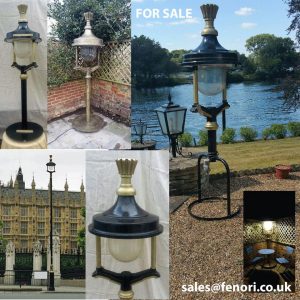
Fenori handles reclaimed Wornum street lights and related components, including examples mounted on stands or adapted for private and project use.
for stock use this search
These reclaimed lights are suitable for:
- Gardens and private estates
- Architectural and landscape projects
- Film, television, and event productions
- Decorative installations requiring authentic street lighting character
Some examples may be shown as previously held stock or archive items, reflecting the rarity and irregular availability of genuine reclaimed street lighting.
Heritage Street Lighting – Related Styles
Fenori specialises in reclaimed British heritage street lighting. Explore other classic designs in our collection:
- Rochester Street Lights – traditional lantern forms used across the UK
- Suggs Street Lights – early 20th-century municipal lighting
- Wornum Street Lights – mid-20th-century London street lighting style
See how these heritage street lights have been used in real projects in our Customer Projects & Gallery.
Availability and Enquiries
Because reclaimed Wornum street lights are not manufactured today, availability varies.
For current stock, sourcing enquiries, or adaptation options:
📞 07770 836 457
✉️ sales@fenori.co.uk
You can also view examples of previously supplied street lighting in our Customer Projects & Archive:
👉 https://fenori.co.uk/customer-pictures-1
Video References
Short videos showing reclaimed Wornum lights mounted on stands:
(These videos illustrate physical form and scale only, not historical attribution.)
Verified Heritage Street Lighting References
For those interested in historic British street lighting, here are authoritative references for Rochester, Suggs, and Wornum styles:
- Rochester Street Lights: Examples of historic Rochester-style lanterns and posts listed on the National Heritage List for England.
- Suggs Street Lights: William Sugg & Co, established in 1837, produced historic street lighting still preserved in the UK.
- Wornum Street Lights: Mid-20th-century street lighting style commonly found in London and conservation areas.
These references demonstrate the historical significance and preservation of British heritage street lighting across the UK.
Wornum Street Lights
The Timeless Charm of Wornum Street Lights: A Glimpse into British Urban History
Streetlights have always been a crucial part of city life, guiding our paths and adding character to the night. Among these urban beacons, the grey Wornum lights stand out as a prime example of British street lighting, blending old-school charm with modern ingenuity. Back in 1958, British architect George Grey Wornum introduced these iconic lights, and they’ve since become a fixture on streets, squares, and landmarks across the United Kingdom but mainly in the capital London.
A Look Back at the Start: How Wornum Lights Came to Be
In 1958, George Grey Wornum brought a new kind of street light to London. He took inspiration from the old Victorian gas lanterns that once lit up the city streets and aimed to give a touch of timeless elegance to the modern cityscape. These lights were initially made from Steel/Copper and caught attention of both city residents and officials.
Adaptation and Evolution: From Cast Iron to Aluminium
As time moved forward, changes were in store. In the 1970s, the Wornum lights switched from steel/copper to aluminium/copper or Steel/copper/ aluminium. This shift not only extended their lifespan but also made them easier to maintain and install. These lights became a distinctive presence along city streets. They emitted a warm, inviting glow that added to the overall atmosphere.
Staying Up to Date with Modern Innovation
Advancements in lighting technology didn’t leave the Wornum lights behind. In the 1980s, the integration of high-pressure sodium lamps took these lights to a new level of efficiency. This upgrade enhanced their energy performance, contributing to a more sustainable urban lighting setup. Then from the 2000 they have been up graded again to use the energy efficient LED lamps.
A Journey through Time: Milestones in Wornum Lights’ History
Let’s take a quick trip through history to see how Wornum lights have evolved:
- 1958 Wornum lights make their first appearance on London streets.
- 1960s Popularity spreads across the United Kingdom as these lights become a common sight in various cities.
- 1970s Transition from cast iron to aluminium marks a significant change in design and materials.
- 1980s The introduction of high-pressure sodium lamps improves energy efficiency.
- 1990s Wornum lights find their place in residential areas, becoming a popular choice for street lighting.
- 2000s A classic British street lighting icon continues to stand strong.
A Symbol Beyond London: Wornum Lights Across the UK
The charm of Wornum lights isn’t confined to London’s boundaries. These captivating lights can be found in other notable cities and towns across the United Kingdom, including Bath, Bristol, and Edinburgh. Their widespread use speaks volumes about their enduring appeal and practicality. They found their way to some of London’s most recognizable spots. The Embankment, Trafalgar Square, Piccadilly Circus, and Regent Street all embraced these lights’ soft glow, adding an extra layer of character to these locations.
Bringing the Charm Home: Your Own Wornum Lights
You don’t have to just admire Wornum lights from afar. With have reclaimed a number of these original lights and they are available in original condition or can be upcycled and rewired, you can bring a touch of this timeless elegance to your own space. Imagine your home, patio, or driveway illuminated by the same classic British charm. As you step outside, you’re greeted by the soft, inviting glow that has graced the streets of London and beyond.
These lights are available to purchase here
A couple of videos of Worms on Stands below
Verified Heritage Street Lighting References
For those interested in historic British street lighting, here are authoritative references for Rochester, Suggs, and Wornum styles:
- Rochester Street Lights: Examples of historic Rochester-style lanterns and posts listed on the National Heritage List for England.
- Suggs Street Lights: William Sugg & Co, established in 1837, produced historic street lighting still preserved in the UK.
- Wornum Street Lights: Mid-20th-century street lighting style commonly found in London and conservation areas.
These references demonstrate the historical significance and preservation of British heritage street lighting across the UK.